How to choose the best 3x3 cube for speedcubing
What to consider before buying your first speedcube: size, magnets and adjustments.
Choosing a cube for speedcubing is no easy task. There are many factors to consider, from its size to its magnets and how adjustable it is.
On top of that, you need to consider the actual design of the cube's pieces, so they don't pop out or get stuck, allowing you to solve it quickly.
When I started speedcubing, there wasn't as much choice. I started as a child, with an old-school Rubik's cube, one of those that didn't even know the meaning of corner cutting. My first speedcube was a Moyu, and the difference was enormous.
I went from solving the cube in around 10 minutes on average (with one miraculous solve of around 4 minutes, if I remember correctly) to just over a minute right from the start. This cube stayed with me for a few years until its stickers fell off from so much use, eventually allowing me to average around 30 seconds with the beginner's solving method.
These days, things have changed a lot and there are hundreds of options, to the point where you no longer know whether one really is "better" than another.
Let's go through each factor to see which might be best for your specific needs. Ultimately, it all depends on your situation:
Your situation | What to prioritize when comparing |
|---|---|
You're learning to solve it | Comfort, consistent turning and ease of use |
You're looking for your first cube to improve your times | Control, stability and simple adjustments |
You already know what feel you like | Speed, magnetic response, size and customization |
You want to replace your current cube | A specific improvement that addresses what bothers you |
What features should you look for in a 3x3 cube?
Several factors should influence your final decision, regardless of your specific situation. That said, depending on your situation, you may already have a clear understanding of some of these features. In that case, they may not be as interesting to you, since they are aimed more at beginners.
In my opinion, when starting out, the most important factors are speed and control, along with corner cutting and lockups. If a cube handles those well, everything else is just an extra, unless you're already counting every millisecond.
Let's look at all the features and how they affect things:
Speed and control
It's important for a cube to turn quickly, but it's also important that it doesn't overshoot, remaining stable and consistent.
To check whether it overshoots, simply pick up the cube and try to turn any layer (usually the top one) by 90º with your dominant hand. Now, try applying the same force several times and see whether the turn is exactly 90º, more, or less, and how far off it is when it isn't exact.
Ideally, the cube should turn those 90º as quickly as possible without overshooting.
For example, here is a ranking of 3 cubes from best to worst in terms of speed and control:
- Moyu RS3M V5: It turns quickly, and usually stops at 90º thanks to its magnets.
- QiYi Warrior M: It turns extremely quickly, but often overshoots 90º, and its poor corner cutting causes lockups.
- DaYan Zanchi: It turns slowly, and almost never lands at 90º. Its saving grace is its excellent corner cutting (sometimes over 45º if properly set up)
Magnets in the pieces and a magnetic core
If you search for magnetic cubes on any marketplace, many are sold as cubes with magnets, but of course, there is a big difference in how their magnets are arranged, since they can have them in 3 different ways. In this section we'll look at two of them, and in the next, the third.
The "best" cubes incorporate all three, but they are also the most expensive, and honestly, they're overkill for someone just starting out.
Cubes with a magnetic core have magnets in the core itself, which help the cube stop with its faces aligned when it turns, rather than stopping halfway.
On the other hand, cubes with magnets in their pieces serve exactly the same purpose, but with a stronger effect than core magnets.
This category depends more on your budget. Regardless of your level, the one with better magnets will always be better, that's simply how it works. Now, if you're on a tight budget, either option will work well for you, though it does depend on the strength of the magnets.
Personally, I much prefer the magnets in the Moyu RS3M V5 Dual Adjustment to those in the QiYi Warrior M, and both have the same number of magnets.
Cubes with a magnetic core tend to be the most expensive, since their system is the most complex of all.
Springs vs MagLev
Now let's look at the core in more detail. Although a cube may have a magnetic core, that doesn't change what type of core it is.
Traditional cubes have springs, which you can adjust with a screw
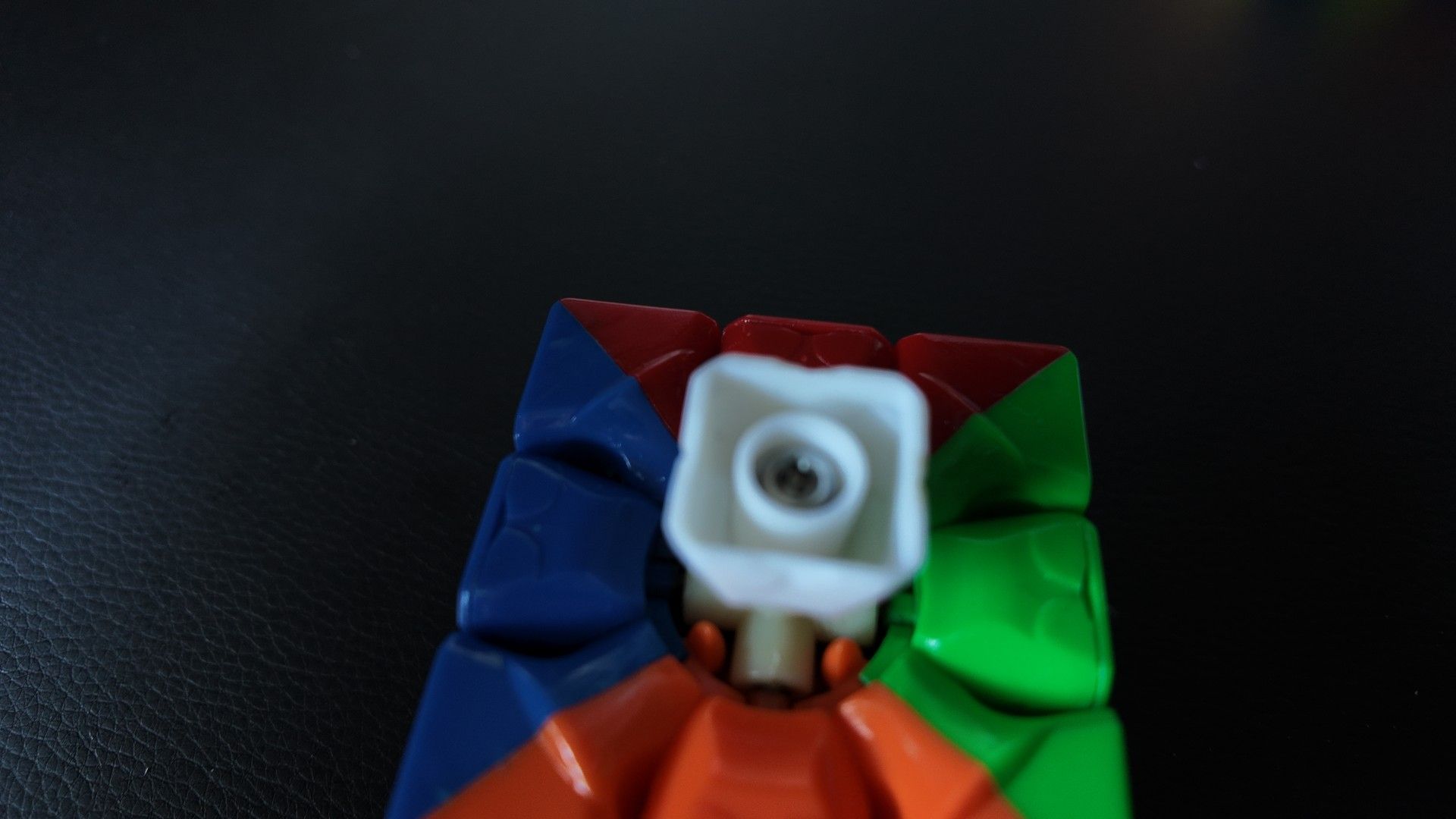
In this photo we can see an adjustment screw on a DaYan Zanchi, with a traditional spring core.
The game changes with the introduction of MagLev cores, which, instead of springs and screws, have two magnets that repel each other, enclosed in a tube, so they are always floating. It's the same concept used by some extremely high-speed trains. I think it's a very interesting concept!
The only downside is that some models doesn't allow you to adjust them. It's important that you verify that before purchasing them. Otherwise, if you like how they feel, they're great.
To find a cube with MagLev technology, just look for MagLev in the name, because if it isn't there, it's extremely likely to be a traditional spring cube.
Corner cutting and lockups during turns
This is one of the most important concepts alongside speed, because without it, the cube locks up while you turn it.
It may not seem like a big deal, but a cube that locks up is no good for speedcubing. It's that simple.
The difference between a cube with good corner cutting and one without it is the design of its edges and corners. Each brand and cube has its own special features that have made this possible, pushing them to some very interesting limits.
In my collection, the cube with the best corner cutting is the DaYan Zanchi, which, with my setup, can manage just over 45º, approximately 45-48º. In other words, more than half the turn. I don't know about you, but I find that incredible.
Now, that doesn't mean this DaYan Zanchi is my favorite, far from it. But it does make it decent for speedcubing (If you have enough strength in your hands to turn it quickly…).
Most adjustable cubes (with springs) can achieve similar results. The problem is that many tend to pop (have pieces pop out) when you adjust them for this, and that's the end of your speedrun.
It's important to have a good balance between corner cutting, and resistance to popping.
Size, weight and exterior finish
Finally, we come to the most personal features of all: its size, weight and exterior finish.
Generally, standard speedcubes are around 54 to 58mm, though some people use 48mm cubes, or even 60mm ones. This comes down somewhat to personal preference.
For example, if you're young or have small hands, a 48mm to 54mm cube will probably be best, while if you're an adult with large hands, 60mm will work well for you. Generally, 54mm or 55mm is the most standard size.
Then, as for weight, while you might like a heavy cube for how it feels in your hand, the most common choice is usually the lightest one, so your hands don't get tired from all that practice in the long run.
When it comes to the exterior finish, there are two factors: color and texture.
Generally, there are two color groups:
- White or black with colored stickers
- Without stickers, with the color in the pieces themselves (stickerless)
These days, almost all cubes are stickerless, because they require less maintenance, which is an advantage in the long run. Previously, when competing with stickerless cubes was prohibited, you had to choose ones with stickers, but now that they're allowed, almost all cubes are stickerless.
Then there's also the texture, which makes a big difference:
- UV coating
- Matte Finish
Those with a UV coating have a satin finish, shine and some of them can feel a little slippery to the touch. The worst thing about them is that they're fingerprint magnets, but that's a minor issue, unless someone is looking for your fingerprints. In that case, I don't recommend them!
Those with a matte finish are rough and offer a better grip. Depending on the brand and model, they can be more or less rough, which depends on the cube itself.
If you go with a matte one, I recommend choosing one that isn't too porous, because they tend to get dirty, and cleaning them is difficult.
Common mistakes when choosing a 3x3 cube
Many people make some very common mistakes when choosing cubes for speedcubing, myself included in some cases, but well, that makes us a little more human, which honestly isn't a bad thing these days.
The most common is buying a cube just because a well-known speedcuber uses it. Many people fall into this trap, without considering that it's very likely a sponsorship. It's better to use your own judgment, rather than choosing something just because someone else uses it.
Another common mistake is confusing different versions of the same model. These days there are hundreds of speedcubes, and it's incredibly easy to mix up versions. Pay close attention to the model year to make sure it's the one you're looking for.
A third serious mistake, which many of us make, is expecting a purchase to replace practice time, or fix problems with our technique. This happened to me personally when I bought my second speedcube, which was going to replace an old Moyu, and was supposedly the best because a world record had recently been broken with it. Well, I'll tell you now, it wasn't my best purchase. It was one of the most expensive cubes I bought, and there it sits, gathering dust.
How to research which 3x3 cube to buy
Once you're clear on all this, my recommendation is to pick up whatever cubes you have on hand.
Now make a short list:
- Start by understanding what kind of turning you like: Do you need more speed? Less speed?
- Then work out what size you like: Bigger? Smaller?
- The same goes for weight
- And texture: UV coating? Matte Finish? Stickers?!
- Finally, in my opinion: What's your budget?
- If you have a large budget (20€ or more), a magnetic core if you don't mind the weight, MagLev, etc.
- If not, for 10€ you can get an inexpensive speedcube that delivers top performance, like the Moyu RS3M V5
- If you need an even lower budget, you can get a QiYi Warrior M for around 5€
- And if you want the very lowest price range, you can find non-magnetic cubes for 3€, like the QiYi Sail W
I'd start with one in range B. You don't need one costing more than 20€ to get started, only if you're already aiming for sub-20 times, solving the cube in under 20 seconds. But ultimately, it's up to you, which is why I wrote this article.